Journal History
Jurnal Desain was established by Universitas Indraprasta PGRI as a scholarly publication platform for research in design, visual art, visual communication, and related fields. The journal began publication in September 2013 with Volume 1, Number 1.
Beginning with Volume 6, Number 1 (September 2018), Jurnal Desain revised its Author Guidelines and manuscript format, including a transition from a two-column to a single-column layout. The journal also began accepting manuscripts in both Bahasa Indonesia and English.
Beginning with Volume 6, Number 2 (January 2019), the journal assigned Digital Object Identifiers (DOIs) to published articles.
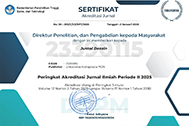
In 2019, Jurnal Desain obtained national accreditation at Rank 5 (SINTA 5) under Decree No. 10/E/KPT/2019. The accreditation covered earlier publications beginning with Volume 4, Number 3 (2017).
Beginning with Volume 8, Number 1 (September 2020), the journal adopted The Chicago Manual of Style, 17th Edition, replacing the previously used MLA 8th Edition and revising its article template accordingly.
In 2020, Jurnal Desain attained national accreditation at Rank 4 (SINTA 4) under Decree No. 200/M/KPT/2020, covering Volume 7, Number 3 (2020) through Volume 12, Number 2 (2025).
Beginning with Volume 11, Number 1 (September 2023), the journal introduced a revised logo and article template and adopted APA Style, 7th Edition, for citations and references.
On April 1, 2024, Jurnal Desain introduced an optional Fast-Track Review service to provide expedited editorial and peer-review processing for eligible manuscripts. The service did not guarantee acceptance or publication.
In July 2024, Jurnal Desain was indexed in the Directory of Open Access Journals (DOAJ).
Beginning in December 2024, authors were required to submit signed publication-integrity documentation through the Integrity Pact (Pakta Integritas) as part of the submission process. This requirement was subsequently developed into the journal's Author Integrity Declaration.
Beginning in January 2025, the journal introduced an Article Processing Charge (APC) of IDR 500,000 for manuscripts covered by the publication-charge policy then in effect.
In February 2025, Jurnal Desain reorganized its editorial structure to strengthen journal governance, editorial coordination, and scholarly management.
From May 6 to June 8, 2025, the journal's website experienced a temporary service disruption following a malware incident. The disruption affected public access to the website and the continuity of visitor statistics for that period.
On July 9, 2025, Jurnal Desain transferred its active editorial and publication operations to the current OJS-based journal website. The former website was retained as a legacy archive for publications from Volume 1, Number 1 (2013) through Volume 12, Number 3 (2025). Manuscripts still undergoing editorial processing were transferred or resubmitted as required to maintain continuity.
In August 2025, the journal undertook further migration and upgrades to its OJS-based management system to improve the continuity and documentation of manuscript submissions, peer review, and editorial decisions.
Beginning with Volume 13, Number 1 (September 2025), Jurnal Desain introduced a revised article template and formally implemented a double-blind peer-review process involving two independent peer reviewers for manuscripts proceeding to external review. Transitional arrangements applied to manuscripts already being processed on the previous platform.
Also beginning with Volume 13, Number 1 (September 2025), the journal increased its publication frequency from three to four issues per year. Regular issues were scheduled for September, December, March, and June.
Beginning with Volume 13, Number 3 (March 2026), the journal further revised its article template and expanded its editorial capacity through the appointment of additional Section Editors and peer reviewers.
In 2026, Jurnal Desain achieved national reaccreditation at Rank 3 (SINTA 3) under Decree No. 295/C/C3/KPT/2026. This upgraded the journal from Rank 4 to Rank 3, with accreditation validity covering Volume 12, Number 2 (2025) through Volume 17, Number 1 (2030).
Publication of Volume 13, Number 4 commenced on June 30, 2026, under the journal's Issue in Progress model, with articles published progressively after completing the required editorial and production procedures. Originally scheduled for the June–August 2026 publication period, the issue was completed on September 30, 2026, during a transitional period of editorial and publication-process adjustments.
Effective from Volume 14, Number 1 (scheduled for September 2026), Jurnal Desain revised its publication-charge policy, setting the Article Processing Charge (APC) at IDR 1,000,000 per accepted article while retaining an Article Submission Charge (ASC) of IDR 0.
Beginning in September 2026, following the issuance of updated national regulations and technical guidelines for scientific-journal accreditation, Jurnal Desain initiated a phased review of its editorial policies, author guidance, peer-review procedures, research-integrity requirements, and website information architecture. The work encompasses the Article Template, Author Guidelines, Submission Preparation Checklist, Peer Review Process, Peer Reviewer Guidelines, publication-ethics and AI policies, research-data provisions, author declarations, publication charges, post-publication procedures, and article metadata and production requirements. These updates are being implemented and verified progressively to improve transparency, accountability, and consistency without interrupting the journal's editorial operations.
Beginning with Volume 14, Number 1 (2026), Jurnal Desain introduced an Article Numbering System, replacing continuous page numbering with unique article identifiers. Each published article is assigned a distinct article number, displayed in its PDF, while retaining independent internal page numbering and its existing Digital Object Identifier (DOI). This transition supports the journal's Issue in Progress publication model and aligns with the 2026 national journal accreditation guidelines, which recognize unique article identifiers as an alternative to continuous pagination.