| Focus and Scope |
| Editorial Team |
| Reviewers |
| Peer Review Process |
| Open Access Statement |
| Publication Ethics |
| Author Guidelines |
| Copyright Notice |
| Publication Fees |
| Abstracting and Indexing |
| Journal History |
| Contact Us |

| Journal Title | : | Lakar: Jurnal Arsitektur |
| Initial | : | LJA |
| Abbrevation | : | Lakar J. Arsit. |
| ISSN | : | Online (2502-227X), Print (2085-2274) |
| DOI | : | 10.30998 by Crossref |
| Editor-in-Chief | : | Okita Sisy Tiara, S.T., M.Arch. |
| Managing Editor | : | Nurjannah Hamdani, S.T., M.Si. |
| Subjects Area | : | Architecture, Architectural Design, Architectural Heritage, Building Science, Building Technology, Interior Design, Landscape Design, Urban Architecture, Urban Design, Urban Studies |
| Type of Peer Review | : | Double Blind Review |
| First Published | : | 2018 (on going) |
| Frequency | : | Biannual (March and September) |
| Publisher | : | Universitas Indraprasta PGRI |
| City | : | Jakarta |
| Country | : | Indonesia |
| Latitude | : | -6.2979 |
| Longitude | : | 106.8502 |
| Contact | : | lakar.arsitektur@gmail.com |

Lakar: Jurnal Arsitektur is a peer-reviewed scientific open access journal. The journal is dedicated to publishing articles concerned with research, theory development, or program applications related to architecture.
Our Journal is concerned with the latest research, studies, and innovations in Architecture field and other related fields, such as Architectural Design, Architectural Heritage, Building Science, Building Technology, Interior Design, Landscape Design, Urban Architecture, Urban Design, and Urban Studies.
Authors are requested to prepare a manuscript in accordance with the Instructions for preparation of manuscript and then to follow the Author Guidelines for submission.
We strongly prefer to receive manuscripts via our online submission system. With using our system, authors can upload manuscript files (DOCX, text, figures, and supplementary information) directly to our office and check on the status of Reviews their manuscripts during the review process.
Publishing Open Access (OA) in a Our Journal means researchers reaching benefit from:
(1) Increased citation and usage, (2) Greater public engagement, (3) Increase the visibility and readership of your research, (4) Wider collaboration, (5) Increased interdisciplinary conversation, (6) You(r) retain copyright, licensed under Creative Commons, (7) Promotion and publicity of quality research, (8) Avoiding duplication, and; (9) Comply with funder mandates.
Our Journal are indexed by the following abstracting and indexing services.
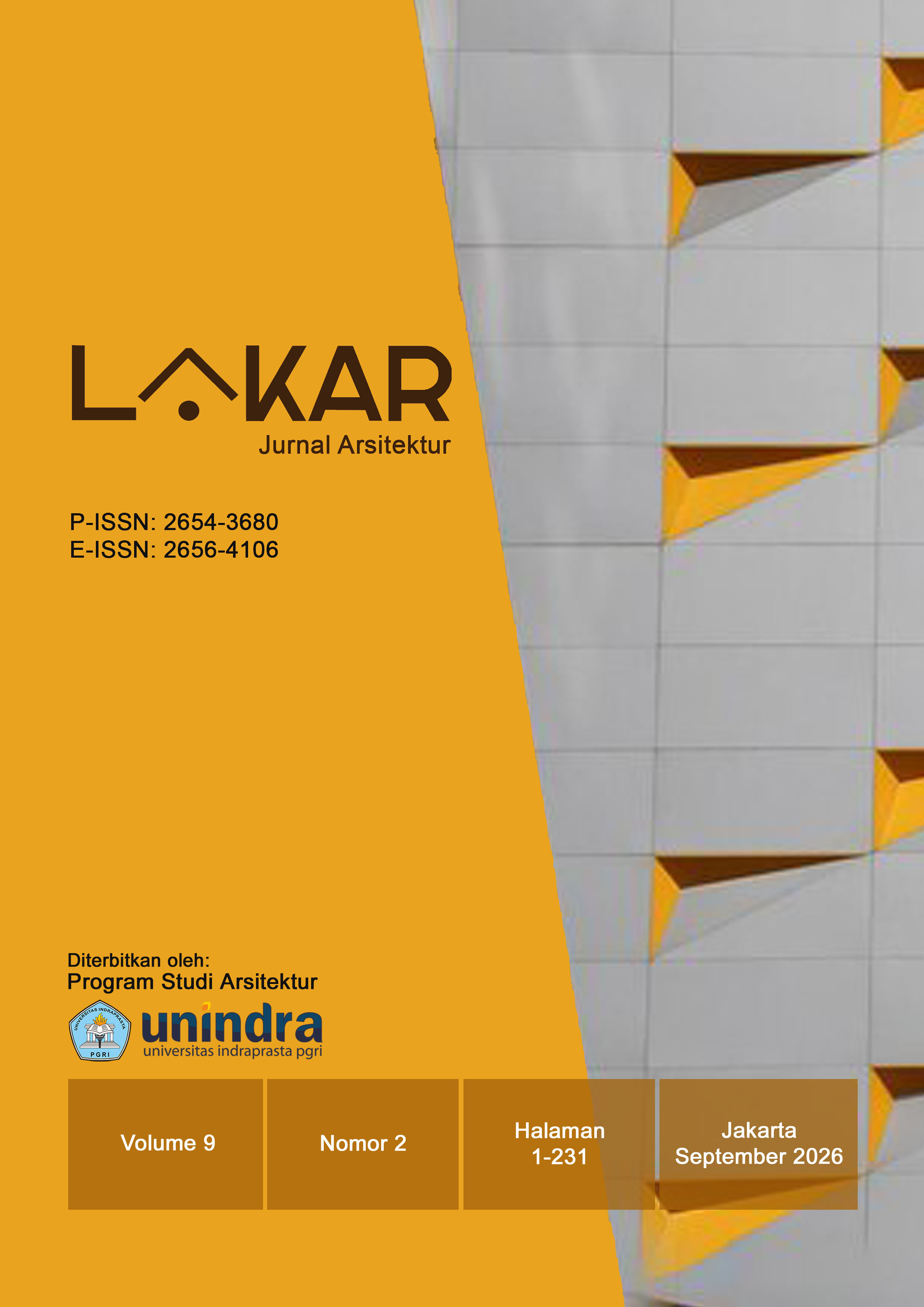
Volume 9, No. 2 of LAKAR: Jurnal Arsitektur presents fifteen empirical studies exploring how architectural strategies, vernacular wisdom, and adaptive urban planning respond to tropical microclimates, environmental hazards, and socio-cultural shifts across Indonesia. In microclimate and passive design, research evaluates user-driven passive cooling in traditional markets, daylighting-thermal balance trade-offs in biophilic workspaces, thermal adaptation in naturally ventilated classrooms, and spatial adaptation of café prayer rooms. Coastal and vernacular typologies are re-evaluated through integrated master planning for fishing villages, organic commercial stilt adaptation along waterfronts, and the modern transformation of Lombok's bale lumbung granary structure into contemporary villas. Addressing ecological vulnerability and disaster mitigation, authors formulate multi-hazard vertical evacuation centers, resident-driven flood adaptation in informal housing, eco-responsive hill tourism planning, and GIS-based visual landscape preservation for agroeco-cultural development. Finally, urban and civic inquiries assess park inclusivity, demonstrate how rapid market restructuring erodes collective memory in historic urban cores, and propose specialized facility designs resolving spatial conflicts in extreme sports venues and performing arts centers. Synthesizing evidence-based methodologies with localized spatial needs, these articles collectively demonstrate that resilient tropical architecture requires an integrated balance between physical environmental performance, cultural continuity, and community behavior.
Publisher:
Universitas Indraprasta PGRI
Address: Jl. Nangka No. 58 C (TB. Simatupang), Kel. Tanjung Barat, Kec. Jagakarsa, Jakarta Selatan 12530, Jakarta, Indonesia.
Phone: +62 (021) 7818718 – 78835283 | Close in sunday and public holidays in Indonesia
Work Hours: 09.00 AM – 08.00 PM
Best hours to visit: From 9 am to 11 am or after 3 pm. The busiest times are between 11 am and 3 pm.

This Work is licensed under a Creative Commons Attribution 4.0 International.







