Frequently Asked Questions

1. What is the current accreditation status of Jurnal Desain?

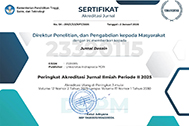
Jurnal Desain is currently accredited at Rank 3, effective from Vol. 12 No. 2 (2025) to Vol. 17 No. 1 (2030), based on Decree No. 295/C/C3/KPT/2026.

The journal is also indexed, abstracted, or discoverable through several scholarly databases and services, including DOAJ, SINTA, GarUDA, Crossref, Dimensions, BASE, Indonesia OneSearch, Scilit, WorldCat, and Google Scholar.

For further information, please refer to the Abstracting, Indexing, and Discovery information provided by the journal.

2. How often is Jurnal Desain published?

Jurnal Desain is published four times a year, with regular issues scheduled in:

September, December, March, and June.

Manuscripts are processed continuously throughout the year. Where applicable, Jurnal Desain may apply an Issue in Progress publication model, allowing final and publication-ready articles to be published progressively within the corresponding regular issue.

3. What types of manuscripts does Jurnal Desain accept?

Jurnal Desain primarily considers:

  • Original Empirical Research Articles;
  • Design Studies and Practice-Based Research; and
  • Conceptually Grounded Scholarly Papers applied to a specific corpus, case, artefact, practice, or visual/material phenomenon.

All manuscripts must present a clearly defined scholarly object, research problem, appropriate methodology or research approach, substantive analysis, and an identifiable scholarly contribution relevant to design, visual art, and visual culture.

Conceptual or theoretical manuscripts may be considered when the scholarly argument is developed through a clearly defined analytical framework and applied to a specific corpus, case, artefact, practice, or phenomenon relevant to the journal's focus and scope.

Jurnal Desain does not accept stand-alone review-based manuscripts whose primary data and principal contribution are limited to reviewing, mapping, classifying, or synthesizing previously published literature without an original empirical or object-based investigation.

This includes Systematic Literature Reviews (SLR), Narrative Literature Reviews, Scoping Reviews, Integrative Reviews, bibliometric studies, literature mapping studies, and comparable review-only manuscripts.

Literature review may be used as part of the scholarly positioning of an eligible research article, but it must not constitute the manuscript's sole research evidence or principal contribution.

Please refer to the Focus and Scope for complete information.

4. How do I submit a manuscript?

All manuscripts must be submitted electronically through the Jurnal Desain Open Journal Systems (OJS).

Before submission, authors should:

  • read the Focus and Scope and Author Guidelines;
  • prepare the manuscript using the official Jurnal Desain Article Template;
  • complete the Submission Preparation Checklist;
  • submit the required Author Integrity Declaration;
  • ensure that all author and manuscript metadata are complete and accurate; and
  • review the applicable publication, ethics, AI, and publication-charge policies.

Registration and login are required to submit a manuscript and monitor its editorial status.

5. Is there a manuscript submission fee?

No.

Article Submission Charge (ASC): IDR 0

Jurnal Desain does not charge authors for manuscript submission or Initial Editorial Assessment.

6. What is the Article Processing Charge?

Effective from Vol. 14 No. 1 (September 2026):

Article Processing Charge (APC): IDR 1,000,000 per accepted article.

The APC is payable only after the manuscript has formally received an Accepted editorial decision.

Payment of the APC does not influence peer review, editorial decisions, or acceptance for publication.

Please refer to the Publication Charges Policy for complete information.

7. Does Jurnal Desain provide an APC waiver?

Yes.

Jurnal Desain provides a 100% APC waiver for articles in which all authors are affiliated with institutions outside Indonesia.

If one or more authors are affiliated with an institution in Indonesia, the article is not eligible for this waiver.

The APC waiver does not influence editorial assessment, peer review, acceptance, or publication priority.

8. How long does the editorial and peer-review process take?

For manuscripts processed through the regular review pathway, the overall process from initial submission to online publication typically takes approximately 3–5 months.

The actual duration may vary depending on reviewer availability, the number of review and revision rounds, the authors' response time, manuscript complexity, and completion of the post-acceptance production process. In some cases, the overall process may take up to six months.

For each regular review round, the reviewer assignment window is normally approximately 28 days from the initial review invitation. Reviewers are generally requested to respond to the invitation within 7 days, with the remaining period used to complete the scholarly evaluation.

The 28-day period applies only to the reviewer evaluation stage and should not be interpreted as the total duration of the peer-review or publication process.

Please refer to the Peer Review Process for complete information.

9. How many reviewers evaluate each manuscript?

Manuscripts that proceed to external peer review are normally evaluated by two independent qualified peer reviewers under a double-blind peer-review system.

The identities of authors and reviewers are concealed from one another.

Reviewer recommendations are advisory. Following revision, the Section Editor evaluates the revised manuscript, the authors' Response to Reviewers, and the reviewers' comments and recommendations, and then provides an editorial recommendation to the Editor-in-Chief.

The final editorial decision remains the responsibility of the Editor-in-Chief.

10. Does Jurnal Desain provide Fast-Track Review?

Yes.

Jurnal Desain provides an optional Fast-Track Review pathway for manuscripts eligible for expedited editorial and peer-review processing.

Fast-Track Review Fee: IDR 500,000 per manuscript.

For manuscripts formally approved for Fast-Track Review, the normal target period for an assigned reviewer to complete one review round is approximately:

Reviewers are normally requested to respond to a Fast-Track review invitation within 3 days and complete the review within approximately 7 days after accepting the assignment, resulting in an overall reviewer assignment window of approximately 10 days from the initial invitation.

Fast-Track Review applies the same scholarly standards, double-blind peer-review procedure, two-reviewer requirement, ethical requirements, and editorial decision criteria as the regular review pathway.

Approval of a Fast-Track request is subject to editorial capacity, reviewer availability, and the applicable Fast-Track quota.

The Fast-Track Review fee is separate from the Article Processing Charge (APC) and does not influence the scholarly assessment, reviewer recommendation, or editorial decision.

11. Does Fast-Track Review guarantee acceptance or an LoA within a specific period?

No.

Fast-Track Review does not guarantee:

  • progression to external peer review;
  • a favorable reviewer recommendation;
  • acceptance;
  • publication;
  • publication in a particular issue; or
  • issuance of a Letter of Acceptance within a predetermined period.

The Fast-Track Review fee applies to expedited editorial and peer-review processing, not to acceptance, publication, or issuance of an LoA.

A Letter of Acceptance is issued only after the manuscript has formally received an Accepted editorial decision.

12. When is a Letter of Acceptance issued?

A Letter of Acceptance (LoA) is issued only after the manuscript has formally received an Accepted editorial decision from the Editor-in-Chief.

An LoA is not issued:

  • during the Initial Editorial Assessment;
  • while external peer review is ongoing;
  • while required revisions remain unresolved;
  • while an additional review round is required; or
  • before the final editorial decision has been recorded.

Jurnal Desain therefore does not guarantee issuance of an LoA within a predetermined number of days or months.

13. How long do authors have to submit revisions?

For manuscripts processed through the regular review pathway, the normal revision periods are:

  • Revisions Required: 14 days
  • Resubmit for Review: 30 days

For manuscripts processed through Fast-Track Review, shorter revision periods may be applied in accordance with the Fast-Track Review Policy and the nature of the revisions required.

The Editor may provide a different revision period depending on the scope, complexity, and scholarly requirements of the requested revisions.

Submission of a revised manuscript does not guarantee acceptance.

14. What is the similarity requirement?

Jurnal Desain normally applies an overall similarity index below 20% as an editorial and technical screening threshold.

However, the similarity percentage does not by itself establish plagiarism.

The editorial team evaluates, where relevant:

  • the source of the similarity;
  • the concentration of matching text;
  • the extent of similarity within a single text block;
  • attribution and citation;
  • direct quotation;
  • paraphrasing;
  • reuse of previously published material; and
  • the overall context of the overlap.

A manuscript below 20% may still contain plagiarism, while a manuscript above 20% is not automatically classified as plagiarism without substantive examination.

Please refer to the Plagiarism Screening Policy for complete information.

15. May authors use Artificial Intelligence when preparing a manuscript?

AI or AI-assisted technologies may be used only in accordance with the Artificial Intelligence (AI) Policy of Jurnal Desain.

Authors must disclose applicable AI use and remain fully responsible for the:

  • accuracy;
  • originality;
  • citations and references;
  • data;
  • analysis;
  • interpretation; and
  • final content of the article.

AI cannot be listed as an author or co-author and must not replace the authors' scholarly judgment or responsibility.

Every published article must contain an Artificial Intelligence Use Statement, declaring whether AI was used in the preparation of the article.

16. May peer reviewers use AI to review manuscripts?

No.

Peer reviewers are not permitted to use generative AI or other AI-assisted systems in the peer-review process.

Reviewers must not use AI to:

  • analyse or evaluate manuscripts;
  • generate or substantially formulate reviewer comments;
  • determine reviewer recommendations; or
  • upload manuscripts, figures, data, excerpts, or other confidential research materials into AI systems.

The peer review must be conducted personally and independently by the assigned human reviewer.

Please refer to the Artificial Intelligence (AI) Policy for complete requirements.

17. Is ethical approval required for every manuscript?

No.

Formal Ethical Clearance is required where applicable to the nature of the research, particularly for studies involving human participants and/or animals.

Where formal ethical approval is required, the manuscript must state:

  • the name of the ethics committee or relevant approving body;
  • the approval number; and
  • the year of approval.

Where informed consent is applicable, the relevant information should also be reported in accordance with the journal's ethical requirements.

For research categorized as low or negligible risk, where formal Ethical Clearance is not required or reasonably applicable, an appropriate Ethical Compliance Statement may be provided in accordance with Jurnal Desain policy.

Authors remain responsible for ensuring that their research complies with applicable ethical, institutional, and legal requirements.

18. Is a Data Availability Statement required?

Yes.

Articles published in Jurnal Desain must include a Data Availability Statement appropriate to the nature of the research.

The statement may indicate that:

  • the data are publicly available;
  • the data are available from the corresponding author upon reasonable request;
  • access to the data is restricted because of ethical, privacy, confidentiality, copyright, contractual, cultural, or intellectual-property considerations;
  • the relevant data are contained within the article and/or supplementary materials; or
  • no new data were created or analysed and data availability is therefore not applicable.

Where data are publicly available, authors should provide the relevant repository, DOI, URL, accession number, or other access information, where applicable.

Jurnal Desain does not require authors to make restricted, confidential, ethically sensitive, copyrighted, or otherwise protected research materials publicly available.

Please refer to the Research Data and Reproducibility Policy for complete information.

19. Can authors withdraw a manuscript?

Authors may request withdrawal of a manuscript for legitimate reasons.

Before peer review begins, a withdrawal request may be considered by the editorial office in accordance with the journal's procedures.

Once peer review has commenced, withdrawal requires an accountable explanation and becomes effective only after written confirmation from the editorial office.

Withdrawal must not be used to:

  • avoid reviewer or editorial findings;
  • evade an ethics or research-integrity investigation;
  • facilitate simultaneous submission to another journal; or
  • manipulate the editorial or publication process.

Please refer to the Publication Ethics and Malpractice Statement for complete provisions on manuscript withdrawal and publication integrity.

20. Where can I find important journal policies and guidelines?

Authors, reviewers, editors, and readers are encouraged to consult the journal's policies and guidelines, including:

  • Focus and Scope
  • Peer Review Process
  • Reviewer Guidelines
  • Author Guidelines
  • Submission Preparation Checklist
  • Publication Ethics and Malpractice Statement
  • Artificial Intelligence (AI) Policy
  • Plagiarism Screening Policy
  • Research Data and Reproducibility Policy
  • Publication Charges Policy
  • Fast-Track Review Policy
  • Open Access Statement
  • Copyright Notice
  • Archiving and Digital Preservation Policy
  • Post-Publication Discussion, Corrections and Retractions Policy
  • Author Integrity Declaration

Applicable policies and guidelines are available through the journal's About section, homepage, and sidebar navigation.